Most small businesses do not fail on social media because they post too little. They fail because they post without a plan: a product photo on Monday, a discount on Thursday, silence for two weeks, then a panicked boost before Eid. A Social Media Strategy for Small Business fixes that by turning random activity into a simple system that ties every post, reply, and taka of ad spend to a business result.
This guide walks you through a nine-step framework you can finish in a weekend, built on 2026 platform rules and data, with Bangladesh-specific numbers, budgets in BDT, and a one-page template you can copy. No agency jargon, no recycled advice from 2023.
Key takeaways
- Goal first, platform second: pick one business goal (sales, leads, footfall, bookings) and let it decide your channels and metrics.
- Go narrow: one or two platforms done well beat five done badly. In Bangladesh, Facebook is the default starting point for most local businesses.
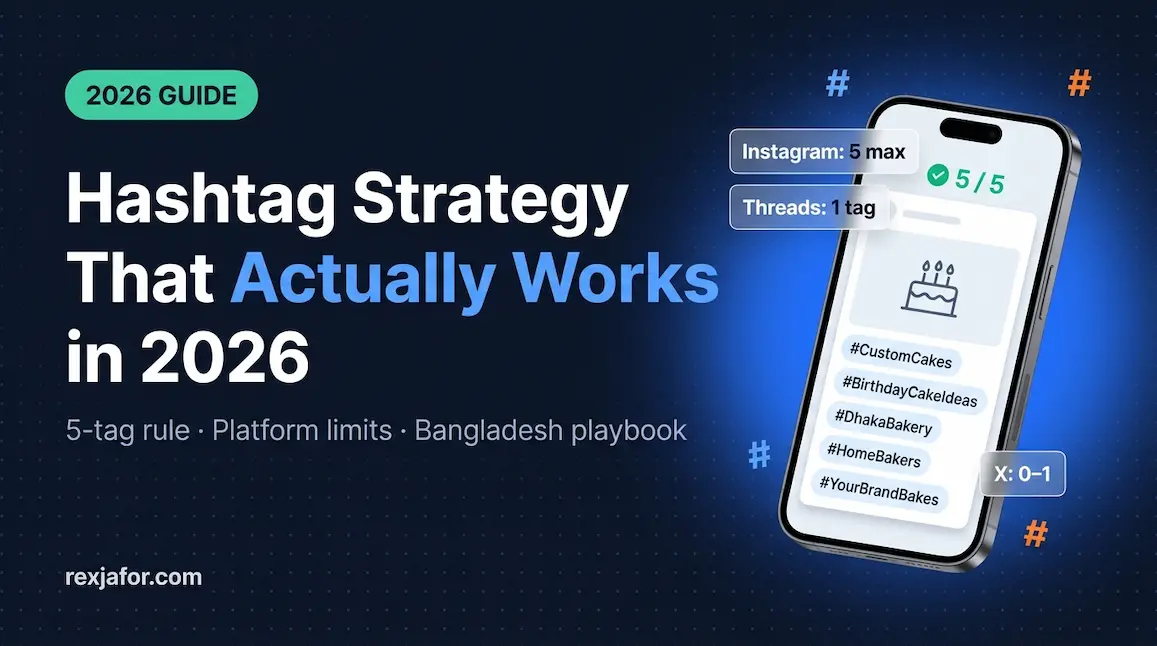
- 2026 rules changed the playbook: Instagram now caps posts at five hashtags, and reach is driven by watch time, shares, and original content rather than tag stuffing.
- Your inbox is part of your strategy: most Bangladeshi social sales close in Messenger or WhatsApp, and Meta's AI Business Agent is now available to businesses of every size.
- Budget realistically: a lean plan can start with free tools and a small, tested ad budget instead of random boosts.
- Review monthly, rebuild quarterly: a strategy is a living document, not a one-time PDF.
What is a social media strategy for a small business?
Definition: A social media strategy is a written plan that states what your business wants from social media, who you are trying to reach, which platforms you will use, what you will post, how you will respond to customers, what you will spend, and how you will measure success.
Think of it as the "why" and "what" behind your social presence. The day-to-day "how" (scheduling, replying, reporting) is social media management, which we cover in depth in our complete guide to social media management. A strategy without management never gets executed; management without a strategy just keeps you busy.
For a small business, the strategy does not need to be a 40-page deck. A good one fits on a single page and answers eight questions clearly. The framework below builds that page step by step.
Why a social media strategy matters for small businesses in 2026
Your customers are already scrolling. The question is whether they find a business that looks consistent and responsive, or one that looks abandoned.
64.0M
social media user identities in Bangladesh (October 2025)
+15.3%
growth in Bangladesh's social media user identities in one year
73%
of social users say they will buy from a competitor if a brand does not respond
According to DataReportal's Digital 2026 Bangladesh report, the country had 64.0 million social media user identities in October 2025, equal to 36.3% of the population, while 82.8 million people were using the internet by the end of 2025. That social audience grew by 8.5 million in a single year. Globally, DataReportal counted 5.79 billion social media user identities at the start of April 2026.
Attention alone is not the story, though. Consumer expectations have hardened. Sprout Social's 2026 statistics show that around 73% of social users would switch to a competitor if a brand does not respond on social, and its Q2 2026 Pulse Survey found that 84% of consumers say response speed shapes how they see a brand afterwards. For a small shop competing with bigger players, a clear plan for replies is one of the cheapest advantages you can build.
Reality check: the same Sprout Social research found consumers want brands to make human-generated content their top priority in 2026. That is good news for small businesses. Your owner-on-camera videos, real customer photos, and behind-the-counter moments are exactly what audiences say they want, and big brands struggle to fake them.
How to build a social media strategy for small business: the 9-step framework
Work through these steps in order. Each one feeds the next, and by Step 9 you will have everything you need for the one-page template further down.
Set one clear business goal (and a number to prove it)
"Grow our Facebook page" is not a goal. It is an activity. Start from what the business needs in the next 90 days, then translate it into a social media objective with a metric attached. Use the SMART format: specific, measurable, achievable, relevant, and time-bound.
| Business need | Social media goal | Primary metric to track |
|---|---|---|
| More online orders | Drive orders from Messenger and WhatsApp inquiries | Conversations started, orders closed, cost per order |
| More walk-in customers | Build local awareness within a few kilometres of the shop | Local reach, direction and call clicks, offer redemptions |
| More bookings or leads | Collect qualified inquiries for a service | Leads, lead-to-sale rate, response time |
| Trust for a new brand | Build credibility with reviews and proof | Recommendations, saves, shares, repeat buyers |
| Loyal repeat buyers | Turn past customers into a community | Returning customer rate, engagement rate, UGC posts |
Example SMART goal: "Get 60 confirmed orders through Facebook and WhatsApp inquiries by the end of the next quarter, at a total ad cost below our set monthly limit." It names the channel, the result, the deadline, and the constraint.
Define your ideal customer in one paragraph
You cannot write for "everyone in Bangladesh." Write one short customer profile instead, based on who actually buys from you today. Check your past orders, your inbox, and your page insights, then answer:
- Who are they? Age range, location (city, district, or neighbourhood), occupation, and household situation.
- What problem do you solve? The job your product does for them, in their words.
- How do they buy? Cash on delivery, bKash or Nagad, card, or in store, and whether they ask questions in the inbox first.
- Where and when do they scroll? Platforms, preferred content formats, and the times they are most active.
- What language works? Many Bangladeshi audiences respond best to native-language content, so test which language and tone lift engagement for your specific customers.
Keep this paragraph pinned above your content calendar. Every post should make sense to this one person.
Audit your current presence and three competitors
Before creating anything new, find out what already works. Review the last 90 days of your own posts and note your top five by reach, messages, and sales. Then study three competitors your customers also consider: what they post, how often, which formats get comments and shares, how fast they reply, and which customer complaints show up under their posts. Those complaints are your positioning opportunities. For a detailed checklist, follow our guide on how to do a social media audit in 7 steps.
Quick competitor scan: note these five things
- Their strongest content format (Reels, carousels, live selling, photo posts).
- Their posting rhythm across a typical week.
- The questions customers repeatedly ask in their comments.
- Their average response time and tone.
- Any gap they ignore: after-sales help, sizing guidance, delivery transparency, tutorials.
Choose one or two platforms that match your customer
This is where most small businesses overreach. Opening accounts on six platforms does not multiply results; it divides your attention. Pick one primary platform where your customers already are, and at most one secondary platform that supports it.
Bangladesh-specific data helps. A Datambar survey conducted in January 2026 of 600 users aged 18 to 64 found that among each platform's users, 95% logged into Facebook daily, 89% used YouTube daily, 84% used TikTok daily, and 76% used Instagram daily, with TikTok and Instagram strongest among 18 to 24 year olds. DataReportal separately reports that TikTok's ad tools showed 56.2 million users aged 18 and above in Bangladesh in late 2025, and LinkedIn reported 12.0 million registered members.
| Platform | Best for | Strong fit if you sell… | Watch out for |
|---|---|---|---|
| Broad reach, local discovery, inbox sales, groups, live selling | Almost anything local: fashion, food, electronics, services, education | Organic reach is limited without strong engagement; plan a small ad budget | |
| Visual products and younger urban buyers | Clothing, beauty, cafes, home decor, handmade goods | Needs consistent Reels and original visuals | |
| TikTok | Fast discovery among young audiences | Trend-friendly products, food, gadgets, lifestyle | Requires frequent native video; reposted content underperforms |
| YouTube | Search-driven video, tutorials, reviews, trust | Tech, education, how-to services, higher-priced products | Slower to build; longer production time |
| B2B trust and decision-makers | Software, agencies, consulting, recruitment, export services | Weak fit for low-ticket consumer products | |
| WhatsApp Business | Closing sales, order updates, repeat buyers | Every business that takes orders by message | Not a discovery channel on its own; feed it from other platforms |
If you are starting on Facebook, set it up properly first. Our guides on creating a Facebook business page the right way and Facebook Page SEO cover the setup details that most new pages miss. Planning to add short video? See our Instagram Reels strategy and TikTok growth strategy for Bangladesh creators.
Set three to four content pillars
Content pillars are the recurring themes you post about. They stop you from staring at a blank screen and keep your feed from turning into a catalogue. Most small businesses need only four:
| Pillar | Purpose | Example for a home bakery |
|---|---|---|
| Educate | Solve a problem and earn saves | "How to store a cake so it stays fresh for three days" |
| Show the people | Build trust with real faces | Owner decorating an order on camera, kitchen hygiene routine |
| Prove it | Social proof that reduces doubt | Customer photos, delivery unboxing, reviews with permission |
| Sell | Clear offers with an easy next step | New flavour launch with "Message us to pre-order" |
A common guideline is to keep direct promotion to roughly one post in five, but treat that as a starting point, not a law. Your insights will tell you the right mix. Encourage customers to share their own photos too; our guide to user-generated content explains how to collect and reuse it with permission.
Format your content for 2026 algorithms
Platform rules shifted noticeably between late 2025 and 2026, and many ranking guides still teach the old playbook. Three changes matter most for small businesses:
- Hashtags are capped, not dead. Instagram announced in December 2025 that posts and Reels are limited to five hashtags, saying fewer, targeted tags work better than many generic ones, as Social Media Today reported. Use them to label your topic, not to chase reach. Our hashtag strategy guide goes deeper.
- Shares and watch time lead. Instagram head Adam Mosseri has named watch time, likes per reach, and sends per reach (how often people share your post by DM) as the most important ranking signals. Create posts people want to send to a friend.
- Originality is rewarded. Instagram now pushes back against accounts that repost other people's content without adding value. Film your own product, your own shop, your own customers.
Build a posting rhythm you can actually sustain
Consistency beats volume. Three strong posts a week that go out every week will outperform daily posting that collapses after a fortnight. Decide your weekly rhythm per platform, then batch-create content in one or two sessions and schedule it in advance using a free tool like Meta Business Suite.
| Business stage | Primary platform | Secondary platform | Weekly time budget |
|---|---|---|---|
| Solo owner, just starting | 3 posts plus daily Stories | Optional | 3 to 4 hours |
| Small team, steady sales | 4 to 5 posts, 2 short videos | 2 to 3 posts | 6 to 8 hours |
| Growing brand with a part-time manager | Daily posting, weekly live session | 3 to 5 posts | 10 to 15 hours |
Plan the month in a simple calendar so pillars stay balanced and festival campaigns (Bengali New Year, Eid, winter sales, Black Friday for online shops) are ready weeks in advance. Use our social media content calendar template and check the best times to post on social media in Bangladesh before locking in your schedule. If writing captions slows you down, these ChatGPT prompts for social media managers help with first drafts, which you should always edit into your own voice.
Plan engagement, customer care, and inbox sales
For many Bangladeshi small businesses, the post starts the sale but the inbox closes it. That makes your response plan a core part of strategy, not an afterthought. Decide in writing:
- Response time target: aim to reply within a few hours during business hours, and never leave a message unanswered beyond 24 hours.
- Saved replies: prepare answers for price, delivery charge, delivery time, sizes, payment methods, and return policy.
- Escalation rules: which complaints the owner handles personally, and how refunds or replacements are approved.
- Public versus private: acknowledge complaints publicly and politely, then move details to private messages.
New in 2026: Meta Business Agent
On June 3, 2026, Meta announced it was expanding its AI Business Agent to businesses of all sizes globally. According to Meta and TechCrunch's coverage, it can answer customer questions, recommend products, book appointments, qualify leads, and hand a conversation over to a person when needed across WhatsApp, Messenger, and Instagram. Meta has also said it plans paid tiers. Use it for repetitive questions, keep a human on sales and complaints, and test every answer against your real price list and policies before switching it on.
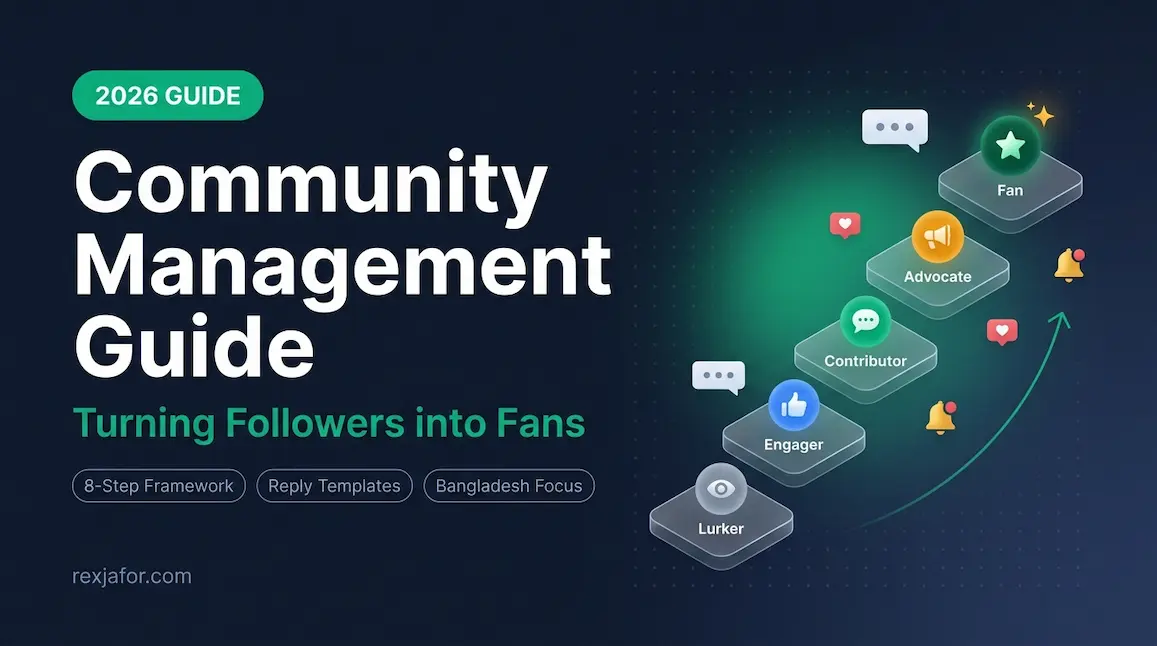
For tougher moments, bookmark our guides on handling negative comments without damaging the brand and community management.
Set a realistic budget for organic and paid
Organic content builds trust; paid ads buy predictable reach. Most small businesses need a little of both. The allocation below is a practical starting framework for Bangladeshi small businesses, not a fixed rule. Adjust it once you know your cost per order.
| Budget item | Lean start | Growth stage | What it covers |
|---|---|---|---|
| Tools | Free | Free to low-cost paid plan | Meta Business Suite, Canva, CapCut free tiers; a paid scheduler only when you manage several platforms |
| Content production | Phone and natural light | Basic lighting, a mic, occasional shoot | Product photos, Reels, customer stories |
| Paid ads | Small daily test budget | Scaled budget on proven ads | Ads Manager campaigns aimed at messages, sales, or local reach |
| People | Owner's time | Freelancer or part-time manager | Posting, replying, reporting |
Two money rules save most small businesses from wasted spend. First, stop hitting "Boost" on random posts; run structured campaigns from Ads Manager with one clear objective. Our beginner's guide to running Facebook ads and Facebook ads budget guide for small businesses in Bangladesh show exactly how. Second, account for tax: Bangladeshi banks have applied 15% VAT to card payments for foreign digital advertising such as Facebook and Google ads under a National Board of Revenue and Bangladesh Bank directive, so check your card statement and include it when you calculate cost per order.
Measure monthly, adjust quarterly
Likes feel good but rarely pay rent. Track the few numbers connected to your Step 1 goal, review them on the same day every month, and rebuild the plan every quarter.
| Funnel stage | Metric | What it tells you |
|---|---|---|
| Awareness | Reach and views | Whether new people are seeing you |
| Engagement | Engagement rate, shares, saves | Whether content is worth passing on |
| Conversion | Conversations started, orders, leads, cost per result | Whether social media is producing revenue |
| Service | Average response time, unanswered messages | Whether you are losing buyers in the inbox |
| Loyalty | Repeat buyers, reviews, customer posts | Whether customers come back and vouch for you |
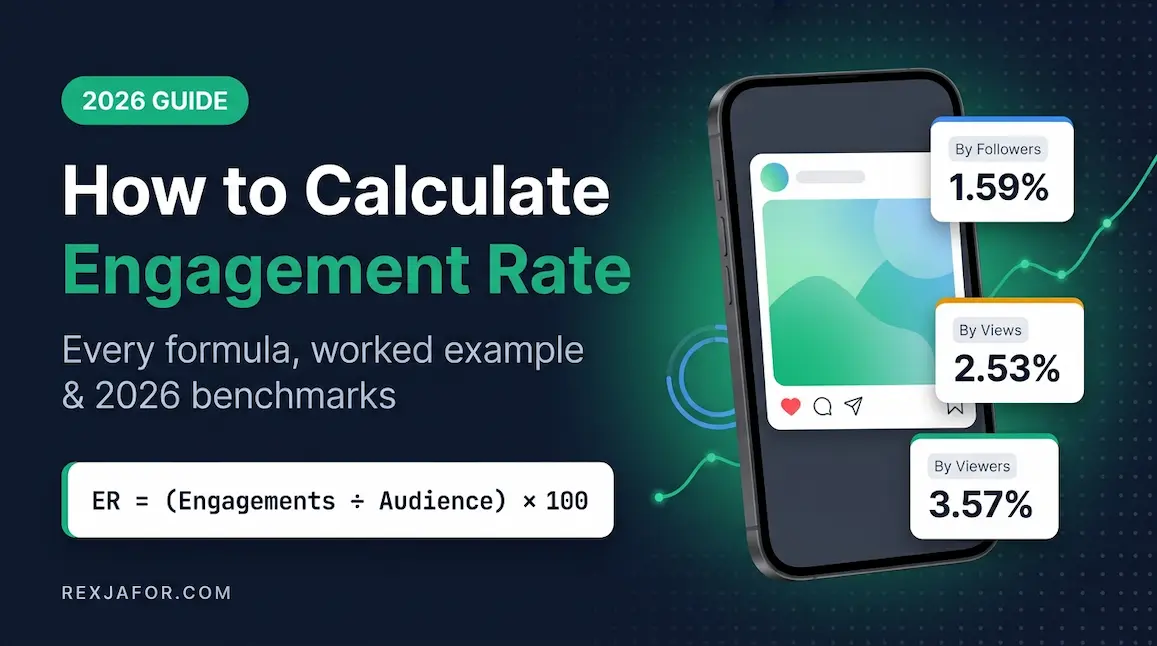
Learn the formulas in our guide on how to calculate engagement rate, and see the full list of social media KPIs you should actually track. A simple habit helps: every month, write down one thing to keep, one thing to stop, and one thing to test next.
Free one-page social media strategy template
Copy this table into a document or spreadsheet and fill in the right-hand column. If you can complete every row in one sentence or two, you have a working strategy.
| Section | Your answer |
|---|---|
| 1. Business goal (SMART) | Example: 60 confirmed orders from social inquiries by the end of this quarter |
| 2. Ideal customer | Who, where, what problem, how they pay, when they scroll |
| 3. Positioning gap | The one thing competitors do poorly that you will do well |
| 4. Platforms | Primary platform plus at most one secondary platform |
| 5. Content pillars | Educate / show the people / prove it / sell |
| 6. Weekly rhythm | Posts, videos, Stories, and live sessions per week |
| 7. Response plan | Reply-time target, saved replies, who handles complaints |
| 8. Monthly budget | Tools, content, ads (including VAT), people |
| 9. KPIs and review date | Three metrics and a fixed monthly review day |
Your first 90 days: a simple roadmap
| Phase | Focus | Deliverables |
|---|---|---|
| Days 1 to 30 | Foundation | Complete the template, fix profile details and contact options, set saved replies, publish consistently, collect baseline numbers |
| Days 31 to 60 | Testing | Try two new formats, run one small ad test with a single objective, gather customer photos and reviews |
| Days 61 to 90 | Doubling down | Scale the best-performing format and ad, drop what failed, write your next-quarter plan from real data |
Bangladesh compliance checklist for social sellers
If you sell through a Facebook page, Instagram, or WhatsApp, a strategy should include the basics that protect your business:
- Digital Business Identity (DBID): Ministry of Commerce guidelines require online businesses, including Facebook-based sellers, to obtain a DBID. Registration has been slow for many applicants, so apply early.
- Watch the draft cross-border digital commerce policy: in July 2026 the Ministry of Commerce published a draft Cross-Border Digital Commerce Policy 2026 for public feedback. As The Business Standard reported, if adopted it would require foreign platforms such as Facebook, YouTube, and Google to register before running ads aimed at local consumers. It is not final yet, but it could affect how ads are billed.
- Honest offers: show real prices and delivery charges, and never post counterfeit or banned products.
- Account security: turn on two-factor authentication and limit page admin access. A hacked page can erase years of work overnight.
What competing guides get wrong (and what is true in 2026)
We reviewed the guides currently ranking for this topic. Several contain outdated or misleading advice. Here is what to ignore:
| What some guides say | What is accurate now |
|---|---|
| Social media has 5.24 billion users | DataReportal counted 5.79 billion social media user identities at the start of April 2026 |
| Add more hashtags to increase reach and discoverability | Instagram capped posts and Reels at five hashtags in December 2025; hashtags now mainly label your topic, while watch time, shares, and originality drive reach |
| Best posting times and usage figures cited from 2023 and 2024 studies | Platform behaviour has shifted since then; use 2026 data plus your own page insights to set posting times |
| Choose platforms using US adult usage data | Bangladeshi usage patterns differ; Facebook, YouTube, and TikTok dominate daily use here, so plan with local data |
| Freelancers cost $30 to $750 per hour, agencies $500 to $5,000 per month | These are US market figures and are not a useful benchmark for Bangladeshi small businesses; budget in BDT against your own cost per order |
| Social media is mainly about posting content | Customer response is now a buying factor; most social users say they will buy from a competitor if a brand ignores them |
Common strategy mistakes to avoid
- Copying a big brand's plan: you do not have their budget or their audience. Build around your own customers.
- Measuring followers instead of sales: a small page with fast replies can outsell a large, silent one.
- Posting identical content everywhere: adapt the format and caption to each platform.
- Letting AI write everything: audiences increasingly reward human-made content. Use AI for drafts and ideas, not your voice.
- Never reviewing results: without a monthly review, the strategy quietly turns back into random posting.
Frequently asked questions
What are the 5 Cs of a social media strategy?
Frameworks vary, but a common version covers content (what you post), community (how you engage), consistency (a sustainable rhythm), conversation (replies and customer care), and conversion (turning attention into sales or leads). The nine-step framework in this guide covers all five.
How many social media platforms should a small business use?
Start with one primary platform and, at most, one secondary platform. Add another only when you can post consistently and reply quickly on the ones you already have.
Which social media platform is best for a small business in Bangladesh?
For most local consumer businesses, Facebook is the practical starting point because of its daily usage and inbox-based buying habits. Instagram and TikTok suit younger audiences and visual products, YouTube suits tutorials and higher-priced items, and LinkedIn suits B2B services.
How often should a small business post on social media?
Consistency matters more than frequency. Three to five quality posts a week on your primary platform is a realistic starting point for most small teams, plus Stories if you have time.
How much should a small business spend on social media?
There is no single right number. Start with free tools and a small, tested ad budget, then increase spend only on ads that produce orders or leads at an acceptable cost. Include the VAT your bank applies to foreign ad payments.
How long does it take for a social media strategy to work?
Expect early signals within the first month and more reliable results after about 90 days of consistent posting, replying, and testing. Paid campaigns can produce results faster once your offer and targeting are proven.
Can I use AI to build and run my social media strategy?
Yes, as an assistant. AI tools can draft captions, suggest ideas, and handle routine inbox questions, such as Meta's Business Agent. Keep strategy decisions, brand voice, complaints, and sales conversations under human control, and fact-check everything before publishing.
Final thoughts
A social media strategy for small business is not about being everywhere or going viral. It is about choosing one goal, one customer, and one or two platforms, then showing up consistently, replying quickly, and letting real numbers guide the next move. Fill in the one-page template this week, follow the 90-day roadmap, and your social media will start working like a sales channel instead of a chore.