If you are chasing YouTube monetization in 2026, you are aiming at a target that just moved. On 10 August 2026, YouTube announced the first significant changes to the YouTube Partner Program since 2018 — and two days later it quietly rewrote the vocabulary the requirements are measured in. Most of the guides currently ranking for this topic were written before either change.
This guide covers the YouTube monetization requirements as they actually stand today, what changes on 1 February 2027, and the part almost nobody covers: what monetization means in practice for a creator based in Bangladesh, from the AdSense payout threshold to the US withholding rate you are entitled to claim and the source-tax confusion at local banks.
KEY TAKEAWAYS
- Two tiers, not one gate: 500 subscribers unlocks fan funding and Shopping; 1,000 subscribers plus watch hours or Shorts views unlocks ad and YouTube Premium revenue.
- Today's ad-revenue bar: 1,000 subscribers and either 4,000 qualified watch hours in 365 days or 10 million qualified Shorts views in 90 days. The two routes never combine.
- It doubles on 1 February 2027: new applicants will need 8,000 qualified watch hours or 20 million qualified Shorts views. Channels already in the program are not affected.
- A new rolling Shorts gate hits everyone: from 1 February 2027, a channel needs 10 million qualified Shorts views in the trailing 90 days to earn ad and subscription revenue on Shorts.
- "Qualified" has a precise meaning: Shorts views must be engaged views — loops do not count, and image posts in the Shorts feed do not count at all.
- Thresholds are the easy part: most rejections come from the inauthentic content, reused content and AI-persona policies, not from subscriber maths.
- For Bangladeshi creators: the US–Bangladesh tax treaty caps US withholding on copyright royalties at 10% — not the 30% most guides assume — but only if you file your tax info in AdSense correctly.
What YouTube monetization actually means
Definition: YouTube monetization means being accepted into the YouTube Partner Program (YPP) — the agreement that lets YouTube pay you a share of the revenue your channel generates through ads, YouTube Premium subscriptions, fan funding features and Shopping. It is free to join, and there are two separate entry points with different thresholds and different earning rights.
Two things follow from that definition, and both trip up new creators. First, "getting monetized" is not a single achievement — you can be a YouTube partner earning from memberships and tips while still being ineligible for ad revenue. Second, YPP is a commercial agreement, so YouTube reviews your channel as a business partner would: it looks at whether advertisers would be comfortable next to your content, not just whether you cleared a numeric bar.
YouTube says the program now has over 3 million creators in it, and that it expects to pay out more in 2027 than in 2026 — a useful frame for reading the 2027 changes, which redistribute money toward active channels rather than simply cutting it.
The two tiers and their exact requirements
There is no single "YouTube monetization requirement". There are two doors, and you can walk through the first one long before the second.
| Tier 1 — Fan funding & Shopping | Tier 2 — Ads & Premium revenue | |
|---|---|---|
| Subscribers | 500 | 1,000 |
| Recent uploads | 3 valid public uploads in the last 90 days | No specific upload count required |
| Long-form route | 3,000 qualified watch hours in 12 months | 4,000 qualified watch hours in 12 months |
| Shorts route (instead) | 3 million qualified Shorts views in 90 days | 10 million qualified Shorts views in 90 days |
| What it unlocks | Channel memberships, Super Chat, Super Stickers, Super Thanks, select YouTube Shopping features | Everything in Tier 1, plus ad revenue on long-form and Shorts, and YouTube Premium revenue share |
| Country availability | Narrower rollout — check the Earn tab in YouTube Studio | Available across 100+ countries, Bangladesh included |
| Changing in 2027? | No — entry thresholds unchanged | Yes — doubles for new applicants on 1 Feb 2027 |
The single most expensive misunderstanding here is thinking the two performance routes add up. They do not. You need either the watch hours or the Shorts views. Long-form watch time never contributes to your Shorts total, and Shorts views never contribute to your watch hours. Creators who split effort evenly between formats often arrive at 2,500 watch hours and 5 million Shorts views and qualify for nothing.
Reality check for Bangladeshi creators: Tier 2 is available in Bangladesh, but Tier 1's country rollout has always been narrower and YouTube publishes that list separately. Do not assume the 500-subscriber door is open to you because a US or Indian blog says it is. Open YouTube Studio → Earn and read what your own dashboard offers; if nothing is available yet, tap Get notified so YouTube emails you when it is.
The five baseline requirements people fail on
Subscriber and view thresholds get all the attention, but they are only the performance half of eligibility. Five administrative requirements apply regardless of channel size, and they are the most common reason a technically qualified channel sits waiting.
- Live in a country or region where YPP is available. Eligibility is tied to where your AdSense account is based, not where your audience is.
- No active Community Guidelines strikes. A single active strike blocks eligibility. Warnings are separate from strikes, but they do not help your review.
- 2-Step Verification turned on for the Google account that owns the channel.
- Advanced features access on your YouTube account — the verification level that also unlocks custom thumbnails and longer uploads.
- One active AdSense for YouTube account linked to the channel. Create it from inside YouTube Studio, not from the AdSense site, or you risk ending up with a duplicate account that cannot be linked.
Get these finished before you hit the thresholds. They cost an afternoon, and having them already in place means you can apply the day you qualify instead of a fortnight later.
What changes on 1 February 2027
This is the section most currently-ranking guides are missing. On 10 August 2026 YouTube published three changes to the Partner Program, all taking effect on 1 February 2027. If you are planning your run at monetization now, this is the calendar you are planning against.
| Requirement | Now (2026) | From 1 Feb 2027 | Who it applies to |
|---|---|---|---|
| Subscribers | 1,000 | 1,000 — unchanged | New applicants |
| Qualified watch hours | 4,000 in 12 months | 8,000 in 365 days | New applicants only |
| Qualified Shorts views (entry) | 10 million in 90 days | 20 million in 90 days | New applicants only |
| Shorts revenue eligibility | No ongoing view minimum | 10 million qualified Shorts views in the trailing 90 days | All partners, including existing ones |
| Tier 1 (fan funding, Shopping) | 500 subscribers | Unchanged | Nobody affected |
| Program terms | Current terms | New terms take effect; review and sign in YouTube Studio | All partners |
Three practical readings of that table:
- If you are close, apply now. A channel accepted under the current 4,000-hour bar keeps its status — YouTube stated explicitly that the update does not affect creators already in YPP. With review typically taking around a month, there is one season left to get in under today's numbers.
- The Shorts gate is the sleeper clause. It is not an entry threshold; it is an ongoing one, and it applies to long-standing partners too. From February 2027, a channel that drops below 10 million qualified Shorts views over a trailing 90 days stops earning ad and subscription revenue on Shorts for that period. It stays in YPP, keeps earning on long-form, and Shorts revenue resumes automatically once it climbs back over the line.
- Something is being offered in return. For channels below the 10-million Shorts line, YouTube says it is introducing milestone-based incentive programs — bonuses tied to YouTube Shopping, incentives for brand deals, and earnings boosts for starting and growing trends. Details have not been published yet, so treat this as announced but unspecified.
YouTube is also expanding Premium Lite to every country where it offers YouTube Premium, which broadens the subscriber base your content earns from even when viewers never see an ad.
Qualified watch hours vs qualified Shorts views
On 12 August 2026 YouTube's Creator Liaison published the precise definitions behind the word "qualified" — the term that has now replaced the older "valid public" phrasing across YouTube's own help pages. If you are counting toward a threshold, count with these rules, not with your dashboard's headline numbers.
| Counts | Does not count | |
|---|---|---|
| Qualified watch hours | Public long-form videos, including podcasts; archived livestreams | Private, unlisted or deleted videos; videos watched as an ad; Shorts watch time; live streams that were never archived |
| Qualified Shorts views | Public Shorts, counted as engaged views — the viewer stayed past the opening seconds | Private, unlisted or deleted Shorts; Shorts viewed as an ad; loops; long-form views; image posts appearing in the Shorts feed |
Two details are worth reading twice. Loops do not count, so the view number on your Shorts is not the number YouTube checks — you can see engaged views per video in YouTube Analytics, and that is the figure to track. And image posts that surface in the Shorts feed contribute nothing, which matters for creators who have leaned into carousels and photo posts for reach.
Podcasts counting as qualified watch hours cuts the other way, in your favour. A weekly hour-long conversation uploaded as a public video accumulates watch hours far faster per upload than short tutorials do, which is why podcast formats are one of the more efficient routes to 4,000 hours — and to 8,000 after February 2027.
How the money is actually split
"Monetized" does not mean one payment stream. Each product in YPP has its own split, and confusing them leads to wildly wrong income expectations.
| Revenue stream | Your share | How it is calculated |
|---|---|---|
| Long-form ads | 55% | Of the ad revenue attributed to your video. The most direct and most predictable stream. |
| Shorts ads | 45% | Not 45% of gross ad revenue. Shorts ad money is pooled, music licensing costs are removed first, the remaining Creator Pool is divided by each channel's share of engaged views in its country — and you receive 45% of your allocated share. |
| YouTube Premium | 55% long-form / 45% Shorts | 30% of net Premium subscription revenue goes into a creator pool, distributed by member watch time and views; your split is then applied to your distribution. |
| Premium Lite | 55% long-form / 45% Shorts | Same mechanism, but 60% of net subscription revenue enters the pool — a higher allocation than standard Premium, reflecting the different product costs. |
| Fan funding | 70% | Channel memberships, Super Chat, Super Stickers and Super Thanks all pay 70% of what the viewer spends, before app-store fees where applicable. |
| Shopping & affiliate | Varies | Commission set by the brand or your own product margin. Available from Tier 1, feature availability varies by country. |
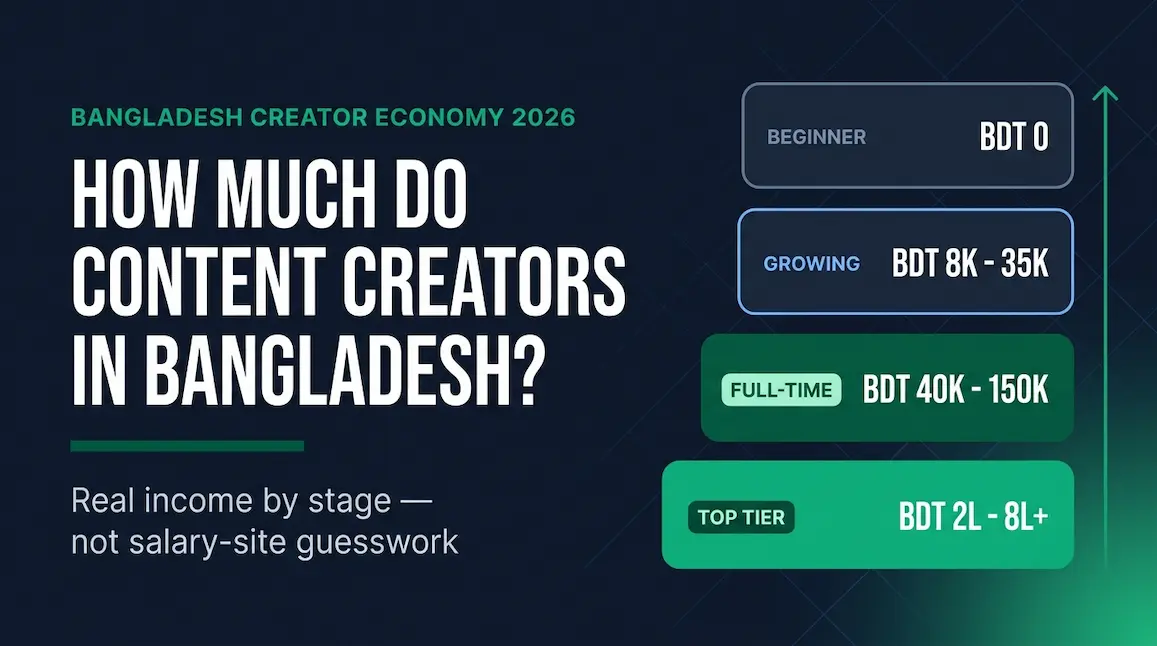
Notice what the 70% row implies: fan funding pays the highest share of any YouTube product. For a small channel with a genuinely engaged audience, a handful of channel members can out-earn ad revenue for a long time — which is exactly why Tier 1 is worth treating as a real income stage rather than a consolation prize. Our breakdown of how much content creators earn in Bangladesh works through what those numbers look like at realistic local audience sizes.
The content policies that sink applications
Hitting the numbers gets your channel reviewed. Policy is what determines whether it passes. YouTube's reviewers cannot watch everything, so they sample: your channel's main theme, your most-viewed videos, your newest videos, the videos carrying the biggest share of your watch time, your titles, thumbnails and descriptions, and your About section. A channel with one strong flagship video and forty template uploads gets judged on the forty.
Five policy areas matter most in 2026, and four of them have tightened since 2025.
- Inauthentic content. In July 2025 YouTube renamed its "repetitious content" policy to "inauthentic content" to make explicit that it covers mass-produced and repetitive uploads. Same intro and outro is fine. A series with a consistent format is fine. Videos that feel interchangeable — templated storylines, image slideshows, scrolling text with no commentary, AI-generated content built from generic templates without your own insight — are not monetizable.
- Reused content. This applies to your channel as a whole, and it is separate from copyright. You can have permission from the original creator and still fail it. Clips stitched together with little narrative, compilations from other platforms, song collections, and readings of material you did not write are the classic failures. Reaction videos, critical reviews, and edited footage where you add storyline and commentary are allowed.
- Unsatisfying or off-putting content. Content leaning on emotionally manipulative formulas, formats so mimicked the videos feel interchangeable, or shock designed purely to harvest views. YouTube's own examples include unrelated AI clips stitched for surprise, and realistic visuals faking a celebrity death or disaster.
- AI personas on sensitive topics. This is newer and absolute: channels using AI-generated personas to present as human experts giving advice on health, legal, financial or political matters are not allowed to monetize. An AI "doctor" giving remedies, AI podcast hosts offering investment tips, AI personas interpreting law — all disqualifying. Using AI as a tool is fine; using AI to impersonate expertise is not.
- Made-for-kids quality principles. If your channel is made for kids, YouTube applies quality principles covering heavily promotional content, encouraging negative behaviours, deceptively educational titles, hard-to-follow videos, sensational or keyword-stuffed content, and strange use of children's characters. A strong focus on low-quality made-for-kids content can get a channel suspended from YPP.
The AI question, answered plainly: AI-assisted content is not banned. Using AI to edit scripts, generate a background visual, or bring an original character you invented to life is explicitly allowed. What is not allowed is generic template output with no added perspective, and AI personas posing as human experts on sensitive subjects. The test is whether a viewer can see your creative judgment in the result.
On top of this, all ad-monetized content must follow the advertiser-friendly content guidelines. A video can sit on a fully monetized channel and still earn limited or no ad revenue if it breaches them — and since March 2025 some ad suitability reviews include a human check, meaning a monetization decision on an individual video can take up to 24 hours.
Monetization from Bangladesh: payments and tax
Every guide ranking for this keyword stops at the thresholds. For a creator in Dhaka, Chattogram or Sylhet, the requirements are only half the problem — getting the money into a local bank account without losing an unnecessary slice of it is the other half.
Getting paid: the AdSense mechanics
- The payment threshold is USD 100 for US-dollar-reporting accounts. Below that, earnings simply roll into the next month.
- Address verification happens early. Once your account first reaches USD 10, Google issues a PIN for address verification. Delivery to Bangladesh can be slow, so enter your address exactly as your postal service expects it and start this step as soon as the account exists.
- The monthly cycle is fixed: the previous month's earnings finalise in the first days of the month, the threshold is evaluated around the 20th, and payment is issued between the 21st and 26th. International transfers then take several more business days to land, so plan for roughly a month and a half between earning and banking.
- Identity, tax info and payment method must all be complete. Any one of them missing holds the payment even when your balance is well over the threshold.
US tax: the 10% most Bangladeshi creators do not claim
Every creator in YPP, anywhere in the world, must submit US tax information to Google. What happens next depends on what you file, and this is where the global guides mislead Bangladeshi readers.
| Your situation | Withholding | Applied to |
|---|---|---|
| No tax info submitted | Up to 24% | Your worldwide earnings — the worst possible outcome, and entirely avoidable |
| W-8BEN filed, no treaty claimed | 30% | Earnings from US viewers only |
| W-8BEN filed, Bangladesh treaty claimed | 10% | Earnings from US viewers only, under the copyright royalties category |
Bangladesh has an income tax treaty in force with the United States, and Article 12 caps source-country tax on royalties — the category YouTube revenue from US viewers falls under — at 10%. In AdSense, that means a Bangladeshi creator who completes the tax interview and claims treaty benefits should see 10% against "Other Copyright Royalties". Seeing 30% there usually means the treaty step was skipped, not that 30% is your rate.
Two things to note. A 30% default rate may still appear beside "Services or Other Business Income" — for a payments profile used only for YouTube, that line is not what your earnings are paid under. And the withholding applies only to the US slice of your revenue: if 8% of your views come from the United States, the rate bites on that 8%, not the whole payout.
Bangladesh tax: where things stand in 2026
This is a moving area locally, so treat the following as the current picture rather than permanent rules, and confirm your own position with a Bangladeshi tax adviser.
- The 7.5% source-tax panic was resolved, messily. In mid-2026 a wave of reports described a 7.5% deduction at source on freelancers' and content creators' inward foreign earnings. The NBR stated there was no provision for such a deduction on freelance or remittance income, the government moved to drop it in the FY 2026-27 budget, and at least one commercial bank suspended the deduction and began refunding amounts already taken. Reporting at the time also noted inconsistent practice between banks — so if your account was debited, raise it with your branch and keep the documentation.
- The ITES exemption is the big one. Income from qualifying IT and technology-based services is exempt from Bangladeshi income tax for the period running to 30 June 2027, on the condition that payment is received through formal banking channels. The bank-channel requirement is the condition — informal routes void it. Whether a particular creator's income qualifies depends on how the activity is classified and documented, which is exactly the sort of question worth paying an adviser for once rather than guessing annually.
- Inward remittance incentive. Foreign earnings arriving through formal banking channels are commonly credited with a 2.5% cash incentive. Banks apply documentation requirements above certain amounts, so ask your bank what it needs before a large payout arrives rather than after.
- Filing is separate from paying. An exemption reduces or removes tax owed; it does not remove the obligation to file if you hold a TIN. Keep every inward remittance record with sender, purpose and amount.
The one-time setup that protects years of earnings: complete the AdSense tax interview and claim your treaty benefit; verify your address as soon as the PIN step appears; route every payout through a formal bank channel into an account in your legal name; and keep a simple ledger of inward remittances. Four items, done once, and they are worth more to a small channel than any thumbnail tweak.
What other guides get wrong
We read the pages currently ranking for this keyword before writing this one. Here are the claims that are outdated or wrong, and what is actually true.
| Common claim | What is actually true in 2026 |
|---|---|
| "Shorts pay 45% of ad revenue." | You get 45% of your allocated share of the Creator Pool, which is what remains after music licensing costs come out of pooled Shorts ad revenue. The effective rate on gross is considerably lower. |
| "You need 1,000 subscribers, 4,000 watch hours and 10M Shorts views." | The watch-hour and Shorts-view routes are alternatives. You need 1,000 subscribers plus one of them. |
| "All YouTubers will need 8,000 watch hours from February 2027." | The doubled thresholds apply to new applicants for ads and Premium revenue sharing. YouTube stated the update does not affect creators already in YPP. |
| "Valid public watch hours" and "valid public Shorts views". | YouTube now uses "qualified" watch hours and views, with published definitions — including engaged views for Shorts, which exclude loops. |
| "The view count on your Short is what YouTube checks." | Eligibility uses engaged views, visible per video in YouTube Analytics. Your public view count will usually be higher. |
| "The 500-subscriber tier is available everywhere YPP is." | Its country rollout is narrower and published separately. Check the Earn tab in YouTube Studio for your channel's actual options. |
| "Non-US creators face 30% US withholding." | 30% is the no-treaty rate. Bangladesh has a treaty with the US capping royalty withholding at 10%, claimable in the AdSense tax interview. |
| "Shorts views don't count toward monetization at all." | Shorts watch time does not count toward watch hours, but Shorts views are a full alternative qualification route — and from February 2027 they also gate ongoing Shorts revenue. |
Applying, waiting and reapplying
The application itself takes minutes. Open YouTube Studio, go to the Earn tab, accept the base terms, then set up or link your AdSense for YouTube account. After that, the "Get reviewed" step shows as in progress.
Review typically takes around a month. It combines automated systems with human reviewers, and it slows down when application volumes are high, when your channel needs more than one pass, or when borderline reused content requires a closer look. You will be emailed the outcome, and the status stays visible in the Earn tab throughout.
If you are rejected, you can reapply after 30 days. After a second rejection, the waiting period is typically 90 days. Use the gap properly: a reapplication with the same forty template videos on the channel will fail the same way. Audit your most-viewed and newest uploads against the inauthentic and reused content policies, remove or unlist what cannot be defended, publish genuinely original work in the interim, and clear any copyright or guidelines issues before trying again.
One caution worth stating outright: if a channel has been demonetized or terminated, do not create new channels or apply with related channels during a suspension period to get around the restriction. YouTube treats that as grounds for terminating all of your channels. The same logic applies to bought subscribers and views — artificially inflating engagement is a creator integrity violation, and YouTube may withhold or charge back earnings associated with invalid traffic and fake engagement.
Staying monetized once you are in
Acceptance is not permanent. Three things will remove or reduce what you earn.
- Inactivity. If a channel publishes no public video and makes no Community tab post for six consecutive months, YouTube may remove access to YPP. Community posts count as activity, which is a useful safety valve if you need a break from filming.
- Policy drift. Reviewers re-check monetizing channels. A pivot into compilations, template formats or AI-persona advice content can cost monetization on a channel that was approved years earlier.
- The rolling Shorts threshold, from February 2027. Shorts ad and subscription revenue will require 10 million qualified Shorts views in the trailing 90 days. Falling below it pauses that one stream, not your membership of the program.
The structural lesson in those three points is the same lesson the 2027 changes teach: a channel that depends on a single stream is fragile. Ad revenue is the one YouTube controls entirely; memberships, Shopping, brand deals and your own products are the ones you control. Building an audience that will follow you across formats — the subject of our guide to personal branding for professionals — is what makes the platform's rule changes survivable rather than existential.
Your pre-application checklist
- 2-Step Verification turned on for the channel's Google account
- Advanced features access granted on your YouTube account
- No active Community Guidelines strikes
- AdSense for YouTube account created from inside YouTube Studio and linked
- 1,000 subscribers confirmed in Studio, not estimated
- 4,000 qualified watch hours in the last 365 days, or 10 million engaged Shorts views in the last 90 days — checked in Analytics, not from the public view counter
- Most-viewed and newest videos audited against the inauthentic and reused content policies
- Titles, thumbnails, descriptions and the About section reviewed — reviewers read all of them
- Any AI-assisted uploads carry visible original perspective, and no AI persona gives health, legal, financial or political advice
- US tax info submitted in AdSense with the Bangladesh treaty benefit claimed
- Address verification PIN step started and payment method added
If you are still building toward the thresholds, the sequencing advice is unglamorous but reliable: pick one format and drive it to its threshold rather than splitting effort across both, publish long enough content that watch hours accumulate per upload, and treat the 500-subscriber tier as a real revenue stage. Our walkthrough on how to become a content creator in Bangladesh covers the earlier stages of that path in detail.
Frequently asked questions
What are the YouTube monetization requirements in 2026?
For ad and YouTube Premium revenue: 1,000 subscribers plus either 4,000 qualified watch hours in the last 12 months or 10 million qualified Shorts views in the last 90 days. For fan funding and Shopping: 500 subscribers, 3 valid public uploads in the last 90 days, and either 3,000 qualified watch hours or 3 million qualified Shorts views. Both tiers also require living in an eligible country, no active Community Guidelines strikes, 2-Step Verification, advanced features access, and a linked AdSense for YouTube account.
Do I need 8,000 watch hours now?
No. The 8,000 qualified watch hours requirement — or 20 million qualified Shorts views — starts on 1 February 2027 and applies to new applicants for ads and Premium revenue sharing. Today's bar is still 4,000 hours or 10 million Shorts views, and channels already in the Partner Program are not affected by the increase.
Is YouTube monetization available in Bangladesh?
Yes. The YouTube Partner Program's ad-revenue tier is available in Bangladesh along with 100-plus other countries, and Bangladeshi creators can receive payouts through AdSense into a local bank account. The 500-subscriber fan funding tier has a narrower country rollout, so check the Earn tab in YouTube Studio to see which options your channel actually has.
How much US tax is withheld from a Bangladeshi creator's YouTube earnings?
If you submit your tax info in AdSense and claim benefits under the US–Bangladesh tax treaty, withholding on copyright royalties is capped at 10%, and it applies only to earnings from US viewers. Without a treaty claim the rate is 30% on US-viewer earnings, and if you submit no tax info at all Google may withhold up to 24% of your worldwide earnings.
Do Shorts count toward the 4,000 watch hours?
No. Watch time from Shorts viewed in the Shorts feed does not count toward qualified watch hours. Shorts have their own separate qualification route based on engaged views. The two metrics never combine — you qualify on one or the other.
What is an engaged view on a Short?
An engaged view means the viewer stayed to watch past the opening seconds of the Short, and it excludes loops. Only engaged views on public Shorts count as qualified for monetization thresholds. You can see engaged views for each video in YouTube Analytics, and the figure will normally be lower than the public view count.
Can AI-generated content be monetized on YouTube?
AI-assisted content can be. Using AI to edit scripts, generate background visuals, or realise a character and narrative you invented is explicitly allowed. What is not monetizable is AI content built from generic templates with no original perspective, and channels using AI personas to present as human experts giving health, legal, financial or political advice.
How long does YouTube monetization approval take?
Usually around a month. YouTube uses automated systems plus human reviewers, and reviews take longer when application volumes are high or when your content needs closer inspection. If you are rejected you can reapply after 30 days, and after a second rejection the wait is typically 90 days.
When does AdSense actually pay out?
Once your unpaid balance passes the USD 100 threshold. Earnings finalise in the first days of the following month, the threshold is checked around the 20th, and payment is issued between the 21st and 26th. An international bank transfer to Bangladesh takes several further business days, so budget for roughly six weeks between earning and receiving.
Can I lose monetization after being approved?
Yes. Six consecutive months with no public upload and no Community tab post can cost you YPP access. Drifting into reused, templated or AI-persona content can trigger removal on review. And from February 2027, dropping below 10 million qualified Shorts views over a trailing 90 days pauses Shorts ad and subscription revenue — though the channel stays in the program and keeps earning on long-form.
Final thoughts: get in before February
The 2026 version of this question has a clearer answer than usual. Today's requirements — 1,000 subscribers and either 4,000 qualified watch hours or 10 million engaged Shorts views — are the easiest they will be for new applicants, and they expire on 1 February 2027. Review takes about a month. That makes the practical deadline for applying under current rules closer to the end of 2026 than to February.
So the plan writes itself: fix the five administrative requirements this week, pick the one format you can actually drive to its threshold, audit your channel against the inauthentic and reused content policies before YouTube does it for you, and complete the AdSense tax interview properly so you are not donating 20 percentage points of your US earnings to a paperwork gap. Do those four things and the thresholds become a matter of time rather than a matter of luck.