Claude AI is Anthropic's AI assistant — and by September 2026 it has grown from a single chatbot into a family of models and apps that write, reason, code, read your files, and run multi-step work on your behalf. If you have heard the name but never worked out where it actually beats the alternatives, this guide is the short version of everything that matters.
Below you will find what Claude AI is, the exact model lineup that is live right now, the eight jobs it genuinely does best, the things it is not the right tool for, current pricing in USD and BDT, how to sign up from Bangladesh, and a prompting method that lifts output quality straight away. Every figure here was checked against Anthropic's own pages in September 2026 — not copied from last year's blog posts.
KEY TAKEAWAYS
- Claude AI is a family, not one model: as of September 2026 the lineup is Fable 5.1, Opus 5, Sonnet 5 and Haiku 4.5, plus the restricted-access Mythos tier.
- Where it wins: long-document analysis, natural-sounding writing, agentic coding, and multi-step work you hand off and walk away from.
- Where it does not: Claude does not generate images or video, and its free tier locks out Projects, Claude Code and Cowork.
- Real prices: Free is $0; Pro is $17/month on annual billing ($200 up front) or $20 monthly; Max starts at $100/month; Team is $20 per seat annually.
- Bangladesh works: Bangladesh is on Anthropic's supported-countries list, but Anthropic takes credit cards only — no bKash, no Nagad, no PayPal.
- Beware stale guides: pages still ranking for "claude ai" cite Claude 3.5 Sonnet as current and quote benchmark scores Anthropic never published. We correct seven of them below.
What is Claude AI?
Definition: Claude AI is a family of large language models built by Anthropic, accessed through the Claude chat apps, the Claude Developer Platform (API), and a set of agent products — Claude Code, Claude Cowork, Claude Design and others — that let the same models read files, run code, browse, and complete multi-step tasks rather than just reply in a chat box.
Anthropic was founded in 2021 and released the first Claude model in March 2023. Three years on, "Claude AI" no longer means one chatbot. It means a tiered set of models you pick from depending on how hard the job is, wrapped in surfaces that suit different kinds of work: a chat window for questions, a terminal tool for code, a desktop agent for file-heavy office work.
What makes Claude different from other AI assistants
Three things set it apart in practice. First, training method: Anthropic trains Claude with a published set of principles it calls Claude's Constitution, which is why Claude tends to reason about tradeoffs instead of confidently guessing. Second, the agent layer is unusually mature — Claude Code and Cowork run long tasks on real files with permission gates, not just chat. Third, Anthropic publishes its own failure data: its September 2026 threat report documents misuse it caught and stopped, which is a level of disclosure most labs skip.
The Claude AI model lineup in September 2026
This is the part most "claude ai" guides get wrong, because the lineup turned over three times between June and September 2026. Here is what is actually current, with Anthropic's published API rates per million tokens (MTok).
| Model | Released | Best for | API price (in / out per MTok) |
|---|---|---|---|
| Fable 5.1 | 1 Sep 2026 | The frontier tier. Long-running agents, heavy reasoning, document-dense professional work. 1M-token context, adaptive thinking always on. | $10 / $50 |
| Opus 5 | 24 Jul 2026 | The everyday heavyweight. Default model on Claude Max and the strongest model on Pro. Anthropic positions it as close to Fable 5's intelligence at half the price. | $5 / $25 |
| Sonnet 5 | 30 Jun 2026 | The workhorse, and what Free users get. Production coding, customer-facing agents, content at scale. | $2 / $10 |
| Haiku 4.5 | Oct 2025 | Fastest and cheapest. High-volume classification, routing, quick summaries. | $1 / $5 |
| Mythos 5.1 | Sep 2026 | Restricted access only, through Anthropic's Project Glasswing. Same underlying model as Fable with some safeguards lifted. Not available to the public. | Not publicly listed |
One detail worth knowing before you pick a plan: Fable and Mythos 5 were pulled offline on 12 June 2026 under a US Department of Commerce export-control order, and Anthropic restored access on 1 July 2026 after the order was lifted. Fable is available again; Mythos stays limited to approved partners.
Practical takeaway for a normal user: you do not need to memorise any of this. On the Free plan you get Sonnet. On Pro you get Opus 5 and metered access to Fable. The model picker sits in the chat window, and Sonnet 5 handles the large majority of everyday work without you touching it.
What Claude AI does best: 8 real strengths
Every AI assistant can draft an email. The question is what Claude AI is better at than the alternative you already have open in another tab. These eight are where the gap is real.
1. Reading long documents without losing the thread
This is Claude's oldest advantage and still its clearest one. Upload a 60-page contract, a research paper, a year of meeting notes, or a messy CSV export, and ask questions that require holding the whole thing in mind at once — "which clauses contradict each other", "what changed between version 3 and version 7", "summarise every objection the client raised". Claude keeps the detail rather than flattening it into a generic summary. For students and researchers, this alone justifies the tool.
2. Writing that does not sound like AI wrote it
Claude's default prose is less padded than most models: fewer stock openers, fewer bullet lists where a sentence would do, less of the "in today's fast-paced world" register. Give it a sample of your own writing and ask it to match voice, structure and sentence length, and it holds the style across a long piece. For blog drafts, client emails, proposals and ad copy, this is the difference between editing lightly and rewriting from scratch.
3. Coding, debugging and whole-codebase work
Coding is where Anthropic has pushed hardest. Claude Code is a command-line tool that reads your repository, plans a change, edits files, runs tests and fixes what breaks — and it is included in every paid plan, drawing from the same usage pool as your chats. In Anthropic's Opus 5 launch notes, the recurring theme from early-access teams was not raw speed but judgment: the model checks its own work, pushes back on a bad design instead of agreeing, and finds root causes rather than patching symptoms.
4. Handing off whole tasks with Claude Cowork
Cowork is the part most people have not tried yet. It brings Claude Code's agent engine to non-developers: you point it at a folder, describe the outcome in plain language, and walk away. Filling an expense report from a folder of receipt photos, reorganising a chaotic Downloads directory, turning a stack of notes into a structured report. It launched as a macOS desktop preview in January 2026, reached Windows in February, and expanded to web and mobile in July 2026 so a task started at your desk can finish while your laptop is shut. It is included with Pro, Max, Team and Enterprise — not with Free.
5. Building things you can actually use, not just text about them
Claude creates real files. Ask for a budget model and you get a working spreadsheet; ask for a pitch deck and you get slides; ask for a calculator and you get an interactive page you can click. Artifacts, file creation and code execution are all available even on the Free plan, which is unusually generous. For freelancers this is the fastest route from "client asked for something" to "client has something in their hands".
6. Research with sources instead of confident guessing
Claude searches the web, reads the pages it finds, and cites them. On paid plans, Research mode runs a longer multi-source investigation and returns a sourced report. The behaviour that matters here is what it does when it cannot find something: it tends to say so rather than inventing a plausible statistic. For anyone publishing content, that habit is worth more than fluency.
7. Skills and Projects: teaching it your way of working once
Two features quietly turn Claude from a tool into a system. Projects (Pro and above) hold documents and standing instructions so every chat inside them starts with your context already loaded. Skills are folders of instructions and scripts that Claude loads only when a task matches — your brand guidelines, your reporting format, your review checklist. Anthropic published the format as an open standard, and Skills are available on every plan including Free. If you repeat any workflow weekly, this is where the time savings compound. Our guide to prompt engineering basics covers how to write instructions Claude follows reliably.
8. Connecting to the tools you already use
Through connectors and the Model Context Protocol, Claude reads from Google Workspace, Slack and a growing list of services, and paid plans add Claude in Chrome and Claude for Microsoft 365. The practical version: instead of copying data into a chat box, Claude goes and gets it.
What Claude AI is not good at
An honest guide has to include this part. Claude is the wrong tool for several common jobs, and knowing which saves you a wasted subscription.
- It does not generate images or video. Claude can write you a detailed image prompt, but it cannot render the picture. For that you still need a dedicated generator.
- The Free plan is deliberately limited. No Projects, no Claude Code, no Cowork, no Research mode, no Opus. Free is genuinely useful for chat, search, memory and file creation — but the features people rave about sit behind $20.
- Usage limits are a budget, not a message count. Every plan resets on a rolling five-hour window, and paid plans add a weekly ceiling on top. A few very long Opus conversations can eat more of your allowance than fifty short ones.
- Context in the chat apps is 200k tokens, not 1M. The million-token window belongs to the models on the API. Anthropic's plan comparison lists 200k for Free, Pro, Max and Team; only Enterprise gets 500k on its default model.
- No local or offline option. Your files and prompts are processed on Anthropic's infrastructure. There is no self-hosted build, which matters if you handle client data under a confidentiality agreement.
- Bangla is workable, not excellent. Claude reads and writes Bengali, but for polished, publishable Bangla copy you will still be editing. Use it to draft in English and localise yourself.
Claude AI vs ChatGPT vs Gemini, in one paragraph
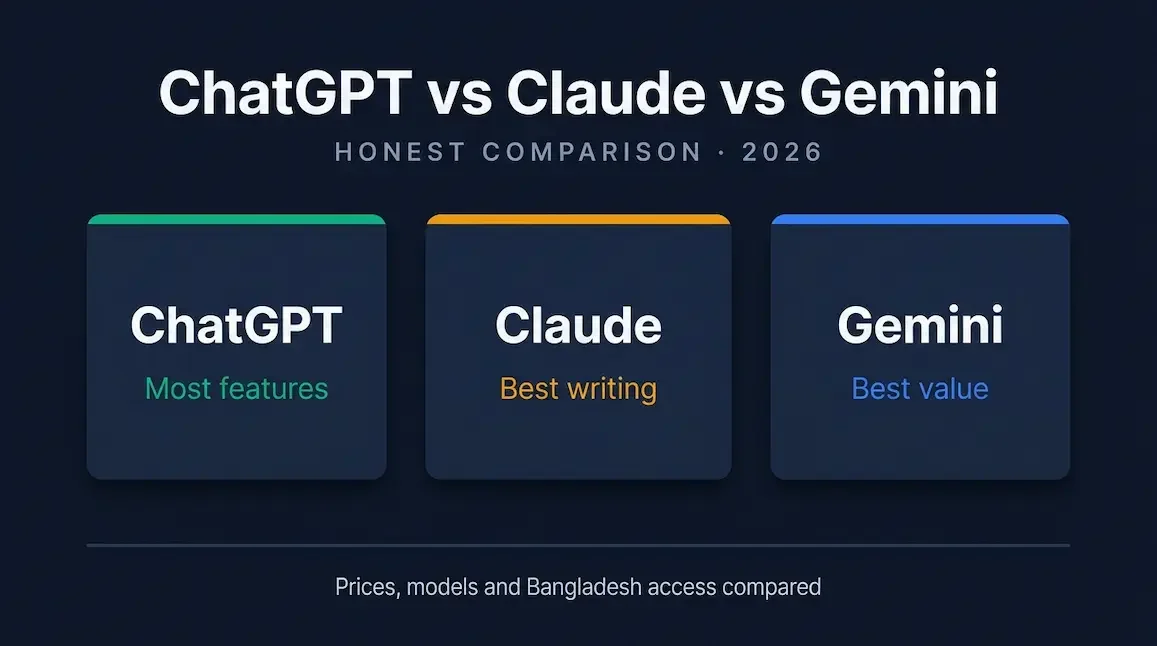
Short version: pick Claude for long documents, careful reasoning, coding and agentic work you hand off. Pick ChatGPT if you want images, voice and the widest plugin ecosystem in one subscription. Pick Gemini if you live inside Google Workspace and want AI sitting in Docs, Sheets and Gmail by default. Most professionals who use two use Claude for the thinking and something else for the media. We break the whole thing down properly in our ChatGPT vs Claude vs Gemini comparison, and if you are starting from zero, the complete AI tools beginner's guide is the better first read.
Claude AI pricing in 2026 (USD and BDT)
These are Anthropic's published prices as of September 2026. BDT figures are converted at roughly 123 taka to the dollar — the mid-September 2026 interbank rate — and are indicative only. Your bank will add an FX margin and card fees on top, so budget around 8–12% more than the converted number.
| Plan | Price (USD) | Approx. BDT / month | What you get |
|---|---|---|---|
| Free | $0 | 0 | Chat on web, mobile and desktop, Sonnet and Haiku, web search, memory, Artifacts, Skills, file creation and code execution, connectors, extended thinking, voice mode. |
| Pro | $17/mo annual ($200 up front), or $20 monthly | ~2,100 / ~2,460 | Everything in Free plus Opus 5, Claude Code, Cowork, Claude Design, unlimited Projects, Research mode, Claude in Chrome and Microsoft 365. The plan most people should be on. |
| Max | From $100/mo (5x) or $200/mo (20x) | ~12,300 / ~24,600 | Pro features with 5x or 20x the usage, higher output limits, priority access at peak times, early access to new features. Capacity, not extra capability. |
| Team | $20/seat annual, $25 monthly (Standard) | ~2,460 / ~3,075 | For 2 to 150 people. Shared projects, SSO, central billing, enterprise search, and no model training on your content by default. Premium seats are $100 annual / $125 monthly. |
| Enterprise | $20/seat plus usage at API rates | Varies | Team plus audit logs, SCIM, role-based access, custom retention, and a 500k context window on the default model. Billed annually. |
The API is a separate budget from any subscription. If you are building something rather than chatting, you pay per token at the rates in the model table above, and there is no monthly fee.
How to use Claude AI from Bangladesh
This is the section every global guide skips. Bangladesh is on Anthropic's official supported-countries list, so you do not need a VPN to sign up or use the free tier. What trips people up is payment.
The payment reality: Anthropic's own pricing page lists credit card as the only payment method for Pro, Max and Team. There is no bKash, no Nagad, no PayPal, no bank transfer, and no local billing partner. You need a card that can charge in US dollars.
In practice that means one of three routes:
- A dual-currency card from a local bank — City Bank, EBL, BRAC Bank, Dutch-Bangla and others issue VISA or Mastercard products with an international wing. You must have dollars endorsed against the card before the charge will go through.
- A virtual dollar card tied to your bank account, which several banks now issue instantly through their apps with a smaller endorsement ceiling.
- A card belonging to a client or partner abroad, which is common for freelancers but leaves the subscription outside your control.
On the endorsement question, there is genuinely good news from this month. Bangladesh Bank's Foreign Exchange Policy Department issued a circular on 6 September 2026 raising the annual personal foreign exchange entitlement from $12,000 to $18,000 per calendar year — a 50% increase, and far more headroom than a $200 annual Claude subscription needs. The interbank dollar rate has settled near 123 taka, so a Pro plan on annual billing costs roughly 24,600 taka a year before card fees.
Two more Bangladesh-specific notes. First, ISPs occasionally get flagged for abuse, which can produce sign-in friction — that is an IP reputation issue, not a country block, and usually clears on a different connection. Second, if you are freelancing on Fiverr or Upwork, your platform earnings withdrawn through a local bank can fund the endorsement directly, which is the cleanest path for most Bangladeshi freelancers.
How to get better answers from Claude AI
Claude rewards structure more than clever phrasing. This five-step method works on any plan and lifts output quality immediately.
The five-step prompt
- Give it a role and an audience. "You are an SEO editor writing for small business owners in Dhaka" beats "write an article" every time, because it fixes the vocabulary and the assumed knowledge level.
- State the job and the constraints together. Word count, format, tone, what to leave out. Claude follows negative constraints well — "no bullet lists, no em dashes, no marketing adjectives" actually works.
- Attach the raw material. Paste your data, upload the PDF, share the draft. Claude is far stronger analysing something you give it than recalling something from training.
- Ask for the plan before the output. "Outline this first and wait for my approval" costs one extra turn and saves rewriting 1,500 words that went the wrong direction.
- Iterate in the same chat. Say what is wrong and what you want instead. Starting fresh throws away all the context you just built.
Two habits worth adding. Turn on extended thinking for genuinely hard problems — analysis, maths, architecture decisions — and leave it off for quick drafting where it just adds latency. And put anything you repeat into a Project's custom instructions or a Skill, so you stop retyping it. Our post on ready-made prompts for social media managers has templates that work the same way in Claude.
Is Claude AI safe to use?
Safety with an AI assistant means two separate things: what happens to your data, and what the model itself is capable of.
Your data. On Free, Pro and Max, your conversations may be used for model training unless you opt out in Settings — so opt out if that matters to you. On Team and Enterprise, Anthropic does not train on your content by default. Incognito chats are available on every plan for conversations you do not want saved at all.
The model. Anthropic publishes more about Claude's failure modes than most labs. On 10 September 2026 it released its most detailed threat intelligence report to date, covering misuse it detected and disrupted between December 2025 and August 2026 across seven areas including cyber operations, surveillance, fraud and weapons development. The company banned the accounts involved, tightened its classifiers, and shared intelligence with authorities and industry partners.
That report is worth understanding for one practical reason: it explains why Claude sometimes refuses or reroutes a request. Anthropic runs real-time classifiers on sensitive categories, and on Fable a flagged request is answered by Opus 5 instead. If you work in cybersecurity and hit an unexpected refusal, that is the mechanism — not a bug.
On alignment, Anthropic's own pre-deployment audit rated Opus 5 its most aligned model to date, with the lowest rates of deceptive behaviour of any recent Claude model. Treat that as a vendor's own measurement rather than an independent verdict, but the direction of travel is clear.
7 Claude AI myths, corrected
These claims all appear on pages currently ranking for Claude AI searches. Each one is wrong as of September 2026.
| What competing guides say | What is actually true |
|---|---|
| "Claude 3.5 Sonnet is the latest model." | Several generations out of date. The September 2026 lineup is Fable 5.1, Opus 5, Sonnet 5 and Haiku 4.5. |
| "Opus 5 scores 96% on SWE-bench Verified." | Anthropic's Opus 5 launch post publishes Frontier-Bench, CursorBench, ARC-AGI 3, GDPval-AA, OSWorld 2.0 and AutomationBench results — but no SWE-bench Verified figure. Third-party sites quote anything from 72.5% to 96% for the same model. Treat unsourced benchmark numbers with suspicion. |
| "Claude gives you a 1M-token context window." | That is a model capability on the API. Anthropic's plan comparison lists 200k for Free, Pro, Max and Team, and 500k on the Enterprise default model. |
| "Claude is blocked in Bangladesh — you need a VPN." | Bangladesh appears on Anthropic's official supported-countries list. The barrier is card payment, not access. |
| "Claude Sonnet costs $15 per million tokens." | Sonnet 5 is $2 per million input tokens and $10 per million output tokens. That price became permanent in August 2026. |
| "The free plan gives you 30 messages a day." | Anthropic publishes no fixed message count. Limits are a rolling five-hour usage budget that depends on conversation length, model choice and which features you use. |
| "Cowork is Max-only and desktop-only." | Cowork is included on Pro, Max, Team and Enterprise, and has been available on web and mobile since July 2026. |
Frequently asked questions about Claude AI
Is Claude AI free?
Yes. The Free plan costs nothing and includes chat on web, mobile and desktop, the Sonnet and Haiku models, web search, memory across conversations, Artifacts, Skills, file creation and code execution, and connectors. Projects, Claude Code, Cowork, Research mode and the Opus model require a paid plan.
What is Claude AI best at compared to other assistants?
Long-document analysis, natural-sounding writing, agentic coding through Claude Code, and multi-step tasks you hand off through Cowork. It is not the right tool for image or video generation, which it cannot do at all.
Which Claude model should I use?
Sonnet 5 handles most everyday work and is what Free users get. Opus 5 is the strongest model on Pro and the default on Max — use it for hard reasoning, long codebase work, and anything where getting it right matters more than getting it fast. Fable 5.1 is the frontier tier for long-running agent work, metered separately on Pro.
Can I use Claude AI in Bangladesh?
Yes. Bangladesh is on Anthropic's supported-countries list and the free tier works without a VPN. Paid plans need an international credit card with dollars endorsed against it — Anthropic does not accept bKash, Nagad or PayPal.
How much does Claude Pro cost in taka?
At roughly 123 taka to the dollar in September 2026, Pro works out to about 2,460 taka a month billed monthly, or about 24,600 taka for the year on annual billing. Add your bank's FX margin and card fees on top — typically another 8–12%.
Does Claude AI write good Bangla?
It reads and writes Bengali competently but not natively well. For published Bangla copy, draft in English and localise yourself, or use Claude's Bangla output as a first pass you then edit. For English content, it is one of the strongest options available.
Does Anthropic train on my conversations?
On Free, Pro and Max, yes by default — you can opt out in Settings. On Team and Enterprise, Anthropic does not train on your content by default. Incognito chats are available on every plan for conversations you do not want retained.
Is Claude Code included in the Pro plan?
Yes. Claude Code is included in every paid plan and shares the same usage pool as your chats, so terminal work and chat draw from one allowance. Heavy users can switch to pay-as-you-go API credits instead.
Can Claude AI replace a developer or a writer?
No, and Anthropic does not claim it does. It compresses the time between having an idea and having a draft or a working prototype. Judgment about what to build, what to publish, and what is wrong with the output still sits with you — and on technical work, reviewing what Claude produces is not optional.
Final thoughts
Claude AI is best understood as a thinking and building tool rather than a do-everything assistant. It will not make you a picture. What it will do is read the thing you did not have time to read, draft in a voice that sounds like yours, fix the bug you have been staring at for an hour, and finish a multi-step job while you do something else.
Start on the Free plan and give it your hardest real task — not a test question, an actual one. If the output changes how your week goes, the $20 is an easy decision. If it does not, you have lost nothing. And whatever you read next about Claude AI, check the model names against the date on the page: in this category, a guide written six months ago is already describing a product that no longer exists.